Nov 28, 2025
7 mins
Architecture, Developer Productivity
Forget “Perfect Architecture”: Build Simple Systems Real Teams Can Actually Work With (Part 1)
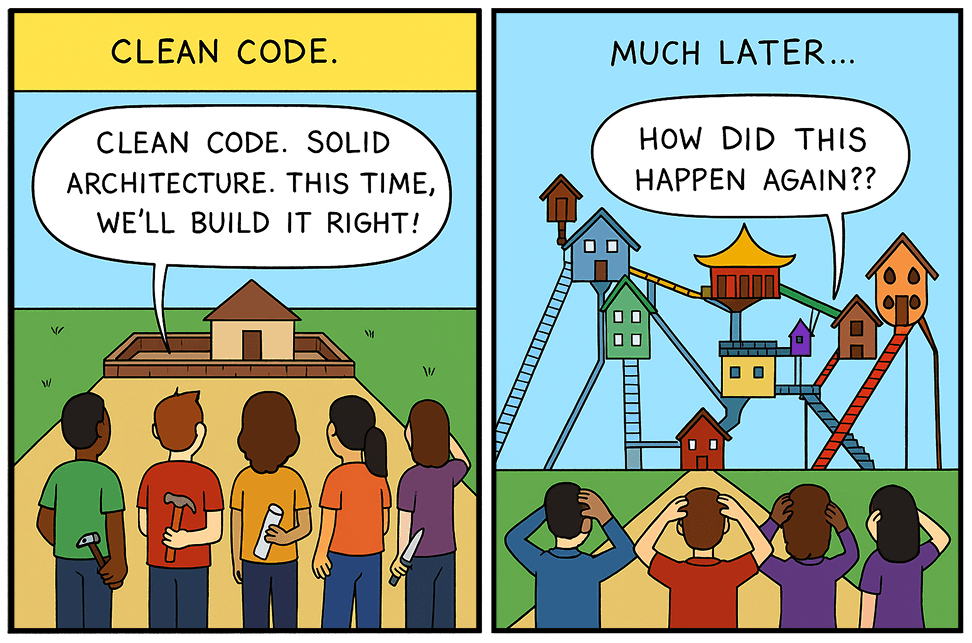
In the last nine years, across dozens of apps and startups, I’ve seen the same story repeat: developers overthink architecture like they’re preparing for an alien invasion. They think they’re preparing the codebase for “millions of users,” crazy scaling, and some future-perfect state… but let’s be honest, that day never comes.
The funny part? 90% of those “future scaling” fears never become real problems - but the over-engineered architecture becomes a very real problem on day one.
The reality?
Most products serve a few thousand loyal users.
Most apps we build are not the next Instagram or TikTok.
Most dev companies and teams build multiple apps in parallel.
Most “critical” decisions made early in a project are based on guesses, not data - because there is no data yet.
And most of the time, deadlines matter more than theoretical purity - especially when a PM is saying “it’s a small change” for the 14th time this week.
A complicated architecture doesn’t just slow development - it kills motivation, burns people out, and makes every task heavier than it should be.
But here’s the twist:
Complicated architecture is bad…
and having no architecture at all is just as dangerous.
When there’s no structure, the codebase becomes a jungle built by five different people on five different days, each with a different mood. Nothing is predictable, everything is hard to reuse, and every feature feels like hacking something together instead of building it properly.
So the real enemy isn’t “too much” or “too little.”
It’s the lack of simple, consistent structure that everyone understands.
That’s why simplicity wins. Always.
Why Developers Struggle to Jump Between Projects
When architecture gets too abstract and philosophical, only the original author understands it - and even they forget after two months.
In real teams, this happens constantly:
people leave
teams shift
companies change vendors
It’s normal.
What’s not normal is expecting new developers to survive a codebase that even the original author struggled with.
The cost is real:
Every time a company switches dev teams or hires new engineers, they waste weeks or months just trying to understand “what the previous devs were doing.”
We’ve seen many projects where devs from another company tried to build some fancy, trendy architecture, got lost inside their own maze, and eventually got replaced. Then we had to jump in, clean up, and rescue the project.
Here’s the truth every developer knows:
Difficult features don’t scare engineers.
Messy architecture does.
And the first step to fixing the mess is brutally simple:
Make it simpler. If it feels too complicated, something is already wrong.
Let’s Be Honest: Every Project Has Its “Monster”
Every team has that one cursed part of the codebase nobody wants to touch.
Everyone says things like:
“I don’t know what’s going on here.”
“The previous team messed this up.”
”Don’t rewrite it. Copy the monster pattern. We’re not ready for a full refactor.”
And with today’s AI tools - Claude, ChatGPT, Gemini whatever - you can’t pretend the monster can’t be understood anymore. The robots will literally explain your own code to you, sometimes better than the person who wrote it.
And if the AI gets confused too?
Congrats - you’ve discovered legacy code so ancient it defeats modern technology.
You can spend a couple hours with AI, go through the mess, understand it, reorganize it, and finally stop being scared of it.
Cleaning the monster is easier than living with it forever.
And once it’s cleaned, the whole team moves faster and breathes easier.
Products Always Change - Your Architecture Must Survive That Chaos
Developers and architects forget this all the time: products change constantly.
The idea of a “finished product” died a long time ago. Things just keep changing forever, usually right after you finish building the previous version.
features evolve
UI gets redesigned
logic is updated
new concepts appear
old features get removed
users request new functionality
business needs shift weekly
This is normal.
So building your architecture tightly around the features you currently have is a huge mistake. Because next month those features will change - and your whole architecture collapses with them.
That’s why architecture shouldn’t be feature-driven - features come and go like interns in a startup.
Architecture should be module-driven.
You want modules you can:
plug in
unplug
update independently
replace without touching the rest
rewrite without breaking everything
That’s how your apps survive real-world chaos.
The Real Solution: A Universal, Modular Architecture for Every App
As a mobile team lead working across multiple apps, I want one thing:
A universal, predictable structure that any developer can jump into without spending two weeks trying to “understand the architecture.”
If every project feels like a different planet, you won’t just burn out - you’ll need a NASA onboarding program just to understand how navigation works.
Different folder structures, naming conventions, navigation patterns, or state management approaches across apps create chaos.
Consistency is not boring -
Consistency is what makes teams scalable.
It:
It creates speed.
It reduces onboarding time.
It helps juniors grow.
It lets seniors focus on building instead of re-learning.
And most importantly - it keeps everyone sane.
A universal architecture doesn’t mean copy-pasting code everywhere.
It means having the same:
flow
logic organization
module boundaries
way of thinking
…so every app feels familiar from day one.
The Only Rule in Architecture: Do What Works for Your Team
There are no universal rules you “must follow.”
No architecture is objectively correct.
You don’t need to copy how Google structures Android internally, or how Apple organizes their frameworks.
And you definitely don’t need to follow whatever the internet says is “the right way.”
You need the structure that works for your people, your deadlines, and your product.
If that means simplifying what others overcomplicate - do it.
If that means reusing the same structure across 20 apps - great.
If that means ignoring trendy architectures - even better.
Because at the end of the day, the goal is simple:
Ship real products.
Ship them reliably.
Ship them without destroying your team.
Ideally before the business team changes the requirements again - usually while you’re still
deploying the previous version.
One last note: this whole article focuses on architecture in a single-stack setup like iOS/Swift projects. If you’re building iOS, Android, and Web at the same time… good luck — that’s a completely different adventure with its own special headaches.
And once I get a bit of free time (whenever that happens), I’ll drop the next part with real examples and some fun chaos to analyze.